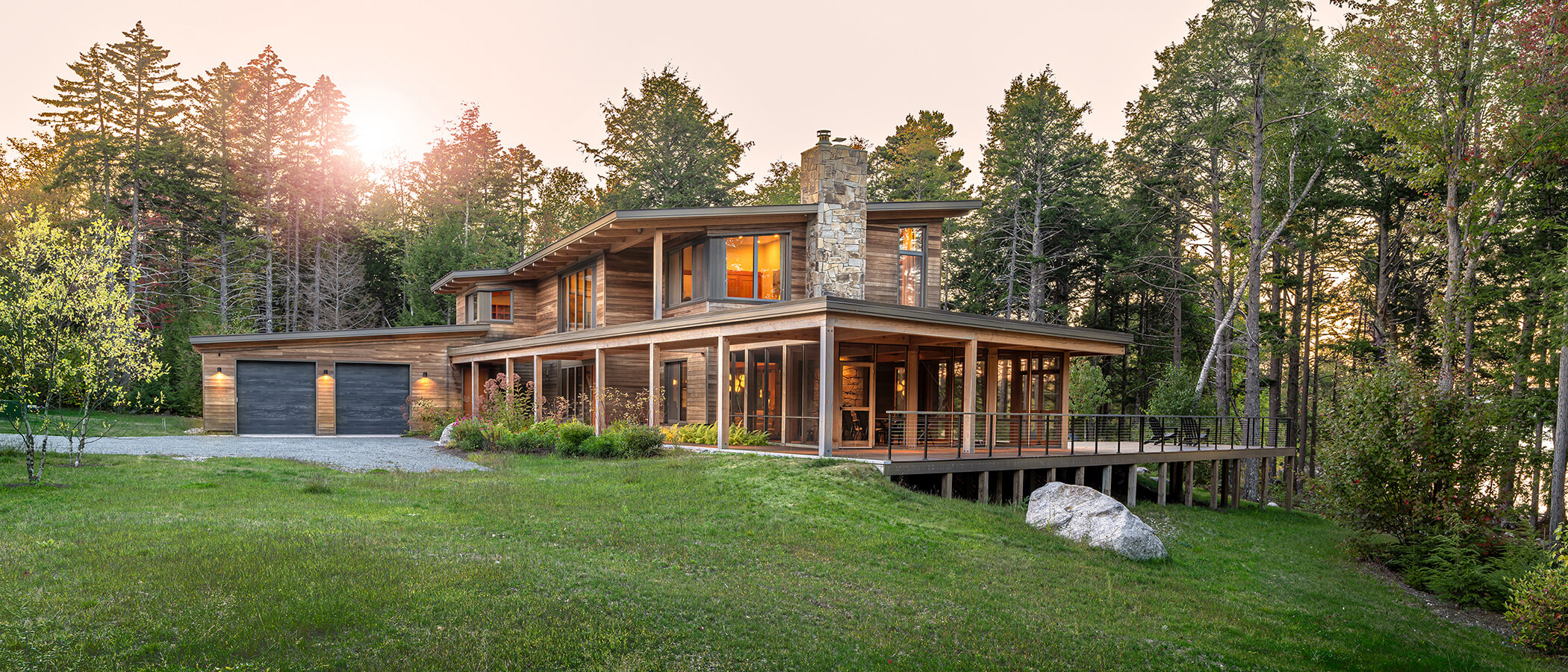
Accessibility and sustainability drive the design of this net-zero modern lakeside retreat.
Our clients came to us with a wonderful lake-side site in Ellsworth. They had a vision for a home that captured the spirit of Maine lake life that was also fully wheelchair accessible. Like many of our clients, they were also passionate about, high-performance, energy efficiency, and durability. With a north-facing site and ideas of porches, decks, and paths to the waterfront, they knew it would be a challenge.
Before the house was placed, the best path for accessibility to the water was established. This led to a design response that made room for a gently sloping ramp that connects the lake path to a gracious deck and screen porch. This nexus became the circulation about which the home’s spaces were organized. The other powerful organizing forces were the view to the water toward the north, and the solar exposure to the south. To take advantage of these, expansive triple pane European-style windows and patio doors were selected to ensure indoor comfort and energy efficiency while providing access and view. Along the south, a covered walkway and large overhangs shade the generous southern windows while providing an architecturally expressive entrance and a sheltered accessible path around the building.
The home also features an efficient ground source heat pump (geothermal) system that provides gentle hydronic heating and cooling that is largely silent and invisible on the main level with discrete panel radiators on the second floor. An energy recovery ventilator provides a gentle constant flow of fresh air while retaining up to 90% of the indoor air temperature.
- Net Zero Ready
- Historic Neighborhood
- Larson Truss Assembly
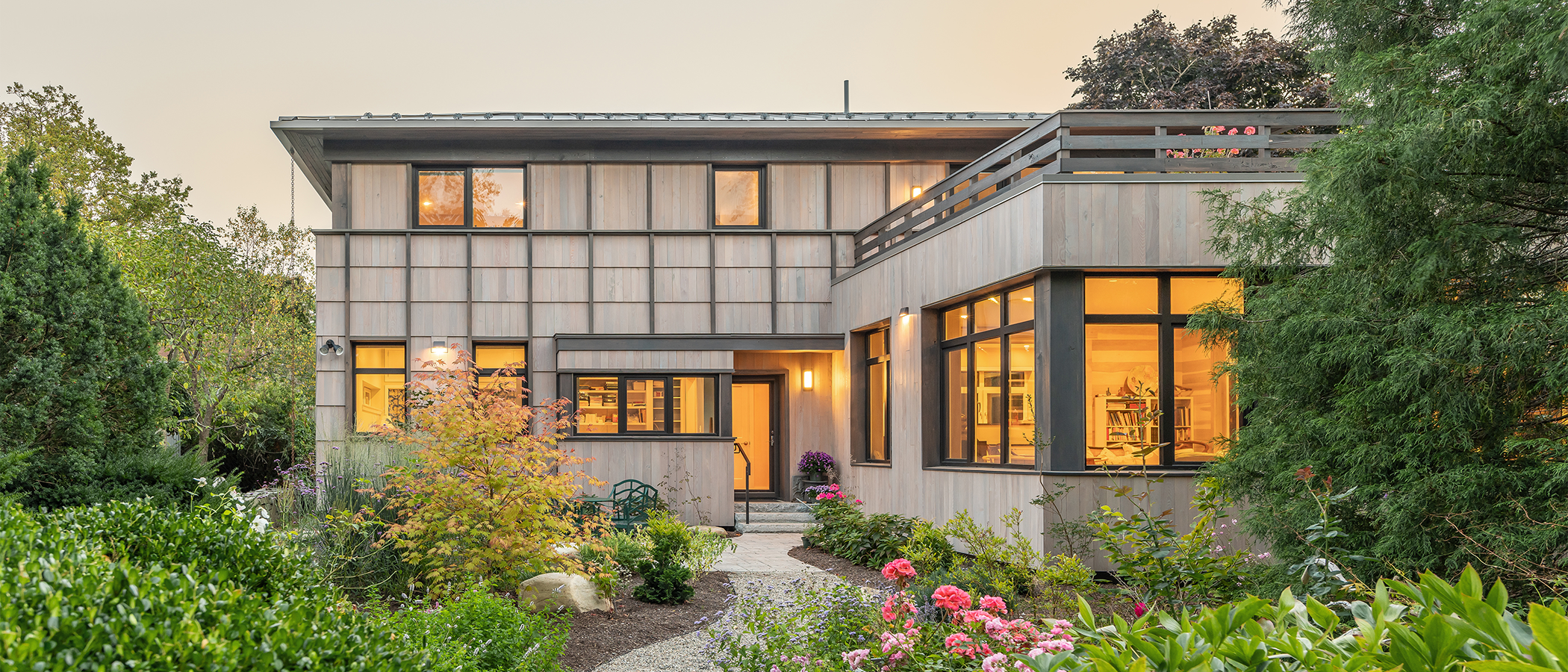
An energy-efficient home in the historic West End Neighborhood of Portland, Maine finds its identity through creative construction details and keen gardening skills.
Ground-up residential projects often start with a blank slate — a vacant lot or a quiet patch of woodland. However, this house, situated in Portland’s historic West End, began its journey on an existing garden plot. Nestled within one of Maine’s oldest and most cherished neighborhoods, this verdant oasis provided a unique and inspiring foundation for the project.
When the owners first approached us to design a house here, we knew it was important to get it right. The garden had been well-maintained for decades and was now a visual staple of the neighborhood. It provided a natural respite for pedestrians navigating the dense, suburban fabric of the West End. Plus, it was beautiful. The garden was an unavoidable contextual feature, one that would influence our design strategy from the start.
Going forward, the main objective was to design a house that remained in dialogue with its surrounding landscape. We began by locating the house on the southwestern end of the lot. This preserved as much vegetation as possible while also forming a central patio space that gave a direct, landscaped connection to the owner’s existing home nearby (occupied by extended family). Next, we worked closely with the owner to minimize the building footprint and increase green space. These two opening design moves were simple, yet fundamental to the project’s successful integration with the garden.

- Net Zero Ready
- ‘Pretty Good House’
An energy efficient home on Beaver Pond becomes a summer cottage, a winter ski chalet, and a source of revenue.
If you live in Maine, you know those beautiful summer days that get you dreaming about cottages on lakes. You probably also know those crisp sunny winter days that get you dreaming of ski cabins. Attaining even one of these dreams can sometimes be a real stretch, but our clients had a clever idea: If they could find the perfect piece of property that is on a body of water AND near a ski mountain, they could build a cozy home that they could rent on Airbnb for large portions of both seasons and still reserve plenty of time for their own family to enjoy. The seasonal income from the Airbnb would help them afford to build a modest, energy-efficient, “Pretty Good House” that their family could enjoy for the foreseeable future. Brilliant! After years of searching, they found just the spot close to Pleasant Mountain on Beaver Pond and reached out to BRIBURN to turn their dream into reality.
This home features all the Pretty Good House principals of being simple in form and reasonably small (for two bedrooms), by having a robust thermal envelope, balanced ventilation, and low-toxin materials. With extra attention to air-sealing details and added passive solar benefits, the home reaches passive house level energy efficiency.
Beaver Pond House takes advantage of its steeply sloped site to create a fully finished daylight basement. Since the main entrance (and the best views and daylight) are on the upper level, the main living spaces have been placed there following an open concept arrangement, with the bedrooms and a small TV room below. The home features double stud walls filled with dense packed cellulose, triple pane European style windows, mini split heat pumps, and a Zhender ERV (energy recovery ventilation) system.
In case you want to share the dream, or just experience what it’s like to hang out in a ‘Pretty Good House’, you can book a stay through Airbnb

- Net-Zero
- Ocean front farmhouse
- New Construction
A net-zero coastal farmhouse designed for long term durability, modern living, & old world charm
This high performance, energy efficient, single family home is perched high above Maquoit Bay with sweeping views of the water. The owners requested a modern home with old world charm, that could be self sufficient for days off grid, healthy and comfortable, and low maintenance, with long lasting durable materials. Designed to meet the needs of a family of 4 (two adults and two children) and their large dog, with provisions for entertaining and aging in place. This is their forever house. Tired of urban living, they relocated to be closer to family, to enjoy the woods, the water, and the more relaxed lifestyle of Southern Maine.
The home was designed based on a traditional New England Farmhouse, with modern styling and amenities. Regional forms and local materials were selected, yet combined in more modern ways to create a design as unique as the setting. The exterior materials (standing seam metal roofing, stained wood siding, and eastern white cedar shingles) are local, durable, and selected to withstand the harsh oceanfront climate. While the interior finishes were selected to create bright, warm spaces, with durability and “old world charm” that will last. Timber framing elements were used at the entry, screen porch, and in the great room.
The house and barn are attached for easy access throughout the year and for cost savings (reduced plumbing and shared bathrooms for the workshop in the garage and the bunkroom above). The bend between the barn and the house responds to the grading on site, breaks down the perceived length of the home, and creates unique and fun corners with views toward the water beyond. The first floor is primarily public space. An open concept kitchen, dining and living area, a large deck and screen porch, all facing east towards the water and south toward the sun. A bedroom suite on the first floor provides a place for visiting family, and a future primary bedroom suite for the owners to age in place. The second floor includes bedrooms, bathrooms, and the “rumpus room” for family activities – exercise and TV watching.
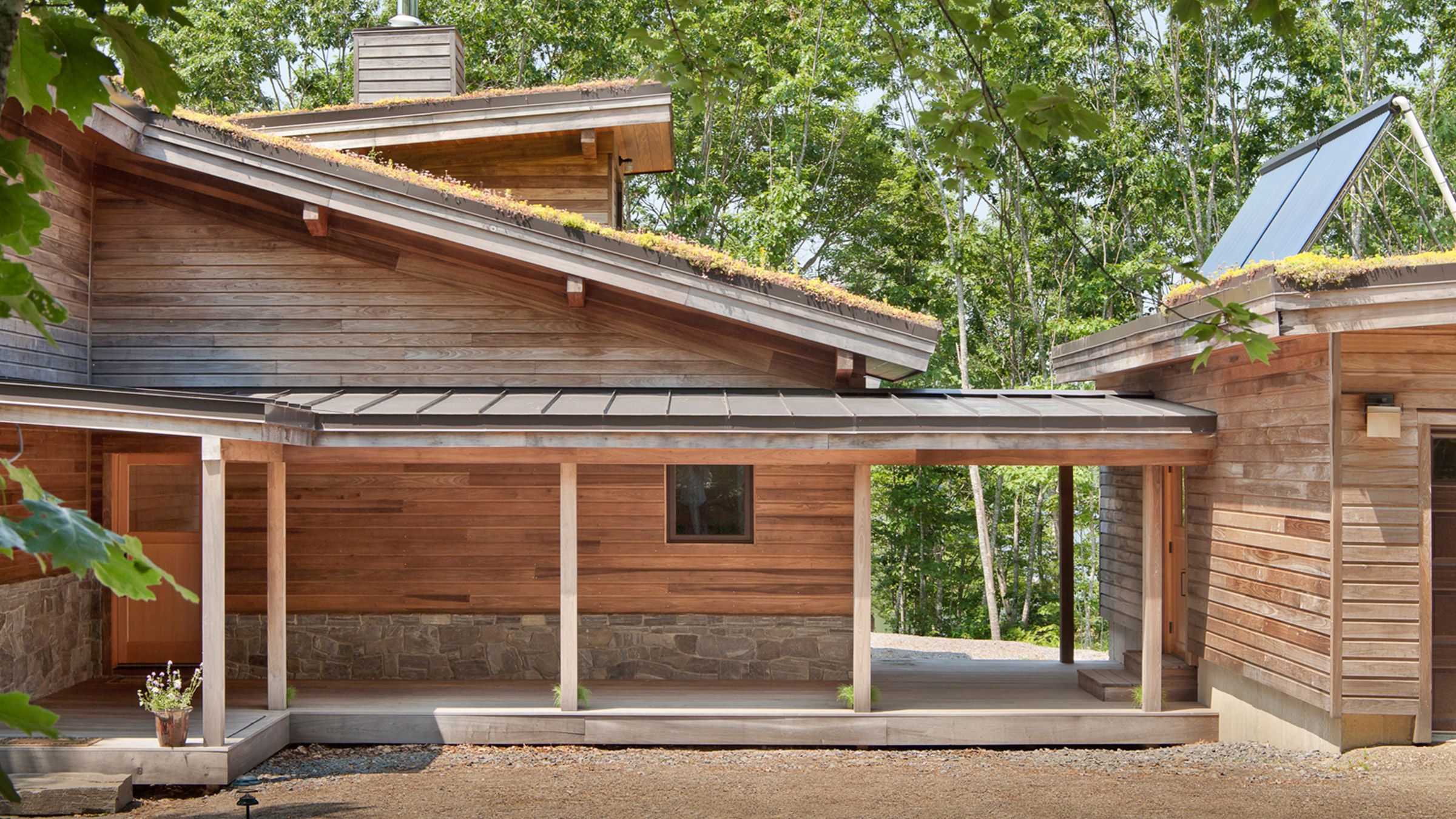
A site inspired home of wood glass and stone.
The request from our client was for a modern, sustainable home, of wood, glass and stone that looked like it ‘belonged’ on its site. The final design is open, warm, well-lit, with an emphasis on natural materials expressed in modern ways. The vegetated roof, planted with hardy alpine sedums, is designed to absorb one inch of storm water, and regulate the house’s temperature during the summer months.
The north tilt of the roof allows for expansive glazing on the south facade to balance the glazing present in the north and west facades, which face the pond. A wide overhang on the south facade and a brise-soleil protect the home from high angled summer sun while allowing in low-angled winter sun. The first floor radiant slab is polished concrete providing thermal mass. A 90-tube solar collector array provides all of the home’s domestic hot water needs and approximately 50% of the remaining space heating.

- HGTV Urban Oasis 2020
- Deep Energy Retrofit
- Addition and Renovation
A deep energy retrofit of a 1900’s home in a Portland suburb, designed for modern day urban living, and featured on HG TV.
A 1900’s home re-imagined for modern day urban living. This unique project was designed for HG TV, to be featured on the television show “Urban Oasis 2020″, and raffled off in a sweepstakes to one lucky family. The project consisted of a gut renovation to the existing building, and two new additions – A new building entry, mudroom and powder room, and a new master bedroom suite.
The original home was constructed using split face concrete block, a rare building material for this location. The uninsulated block walls were cold and drafty, requiring significant renovations to remedy. A new wall system was overlaid on the existing block wall consisting of 3” rigid insulation, weather barrier, strapping and siding; combined with new triple-glazed windows and doors, and new heating an cooling systems, the renovated home is 6X more energy efficient.

- Net Zero Ready
- Urban Infill
- New Construction
A bright urban site with panoramic views
Built on a small urban infill lot this new four story, energy efficient, single family home boasts spectacular views over Casco Bay. Open concept third floor living and dining room, as well as a fourth-floor mezzanine and rooftop deck that offers sweeping views, copious amounts of natural light, and outdoor space.
Our client, eager to move into the city, wanted a home with views of Casco Bay, natural lighting, and easy access to restaurants and cultural venues nearby. Working with the limitations of a narrow vacant lot, the city’s strict zoning ordinance and design standards, and a neighborhood concerned over losing its identity, Briburn worked to develop a home that blended modern living with traditional aesthetics.
The new home includes some unique features. A two-car garage located on the first floor, three bedrooms and a laundry room on the second floor, a large open concept kitchen/dining/living area on the third, and a fourth floor that includes a mezzanine and a large outdoor roof deck for entertaining. Raising the public spaces to the third and fourth floors created an opportunity to capitalize on views of Portland ‘s harbor and increased natural lighting. A stair located in the middle of the north side of the home creates a vertical light shaft that brings natural light into the center of the home, and an elevator was provided for easy access.
- Net Zero Home + Studio
- New Construction
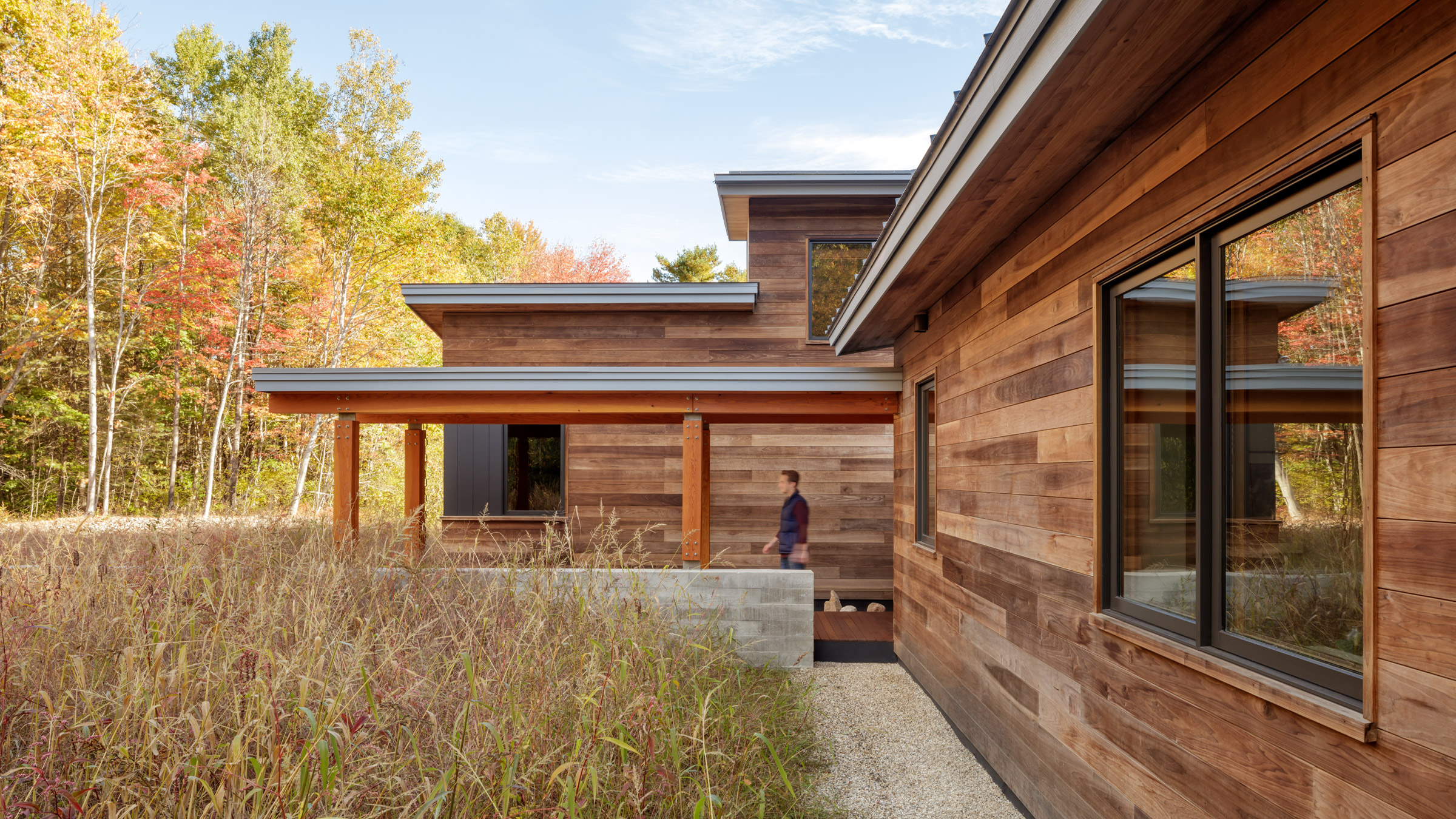
An energy efficient single-story home with detached garage + a separate artist’s studio, all capable of reaching net zero energy goals.
The goal was to build a 2,000 square foot energy efficient home and artist’s studio capable of reaching net zero energy goals, to be located on a wooded 10-acre lot on the shores of the Royal River in North Yarmouth . The structures are sited to create visual and acoustic separation, while maximizing views east to the river, and southern orientation for natural light and heat gain in the winter.
The home was designed for single story living, and for aging in place. Two bedroom suites are provided on either end of the home, with the living spaces located in the middle. Space for easy circulation is provided, along with wide doors into all rooms. Our clients large collection of artwork is showcased throughout, with gallery space provided between the entry and living spaces, and custom built glass shelves located beneath the transom windows , which can be found in most rooms.
The exterior finishes were chosen for their natural beauty and low maintenance properties and to blend with the earth tones found on site. Locally harvested, thermally modified poplar, which requires no paint finish and is termite and rot resistant, is used for the siding, and the trim around the aluminum-clad wood windows is a poly-ash material. Both the windows and trim are painted dark bronze to create a unified appearance.

- Net Zero Ready
- Lake House
- New Construction
A comfortable, contemporary, energy efficient lakeside home.
A home designed for aging in place, and entertaining family and friends. Our client desired an easy-to-maintain, energy-efficient, and accessible home that would let in water views at every turn. The design is made up of two intersecting volumes with a tall single story to the west that holds the kitchen and great room, and two stories of bedrooms on the east, where they get sunrise light.
The home features 12-inch thick double-stud exterior walls with dense packed cellulose, triple-glazed windows and doors, four inches of rigid insulation beneath the concrete slab, deep roof overhangs to control light on the south side, a highly efficient gas boiler, radiant in-floor heating, and an energy recovery ventilator to circulate fresh air. The exterior finishes were chosen for their natural beauty, and low maintenance features.
- Addition + Renovation
- Energy Efficiency
- Lake House
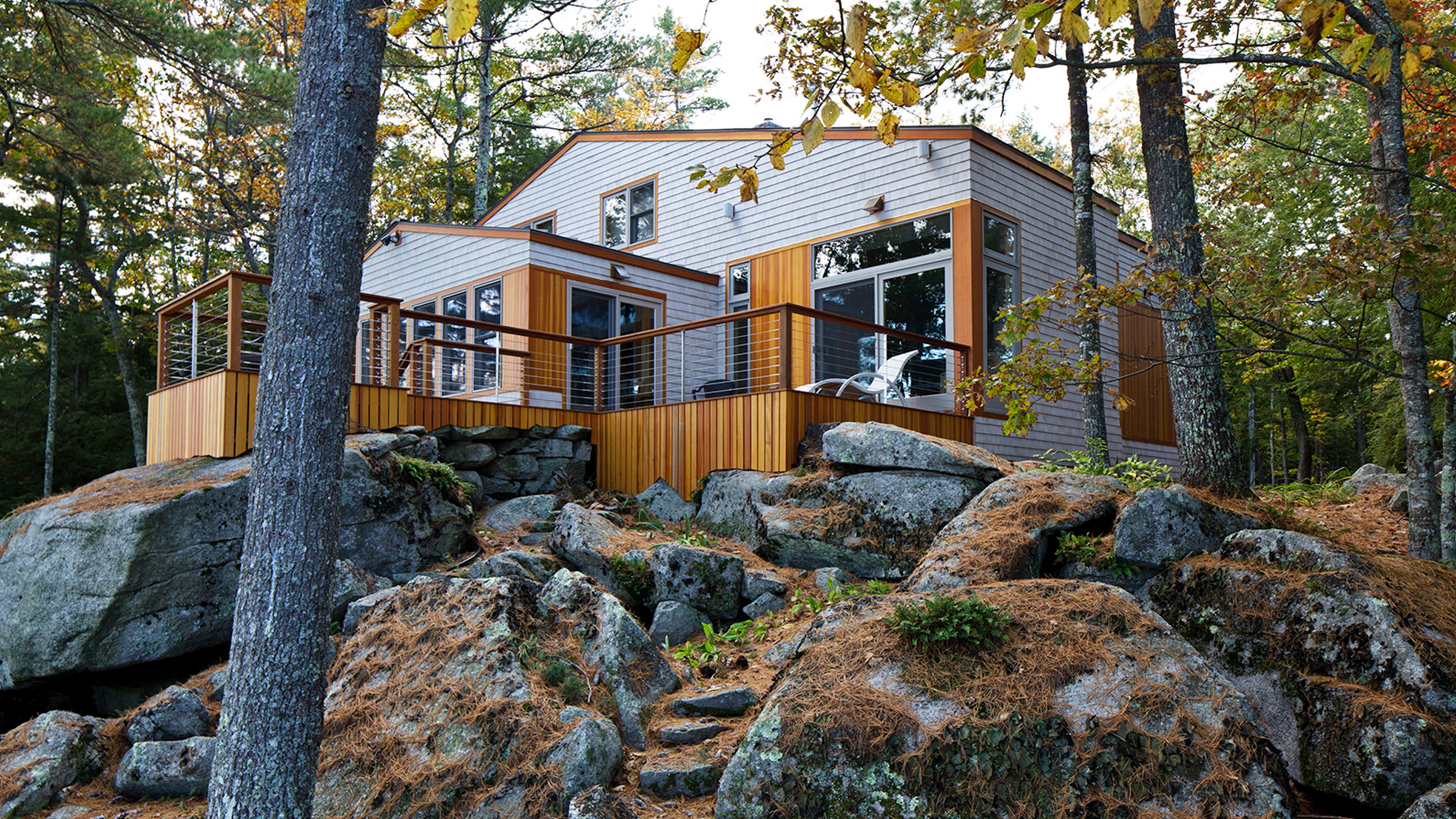
A 1950’s lake house “camp” transformed into an energy efficient, modern home, for year round use.
This second home is located on a rocky outcrop on the shore of Sebago Lake. The family fell in love with the Lake years ago and each summer, would rent local homes and cruise the shores for available properties. When they found this land, they knew that they had found their dream. The existing structure, however, was not what they were looking for.
A new entry and mudroom was added on the west side, a new stair was added on the south and a primary bedroom suite was added to the north. Within the existing envelope we renovated the kitchen and two bathrooms, added a new pantry and laundry room and reconfigured the second floor to create three bedrooms.
- Net Zero Ready
- Urban Infill
- New Construction
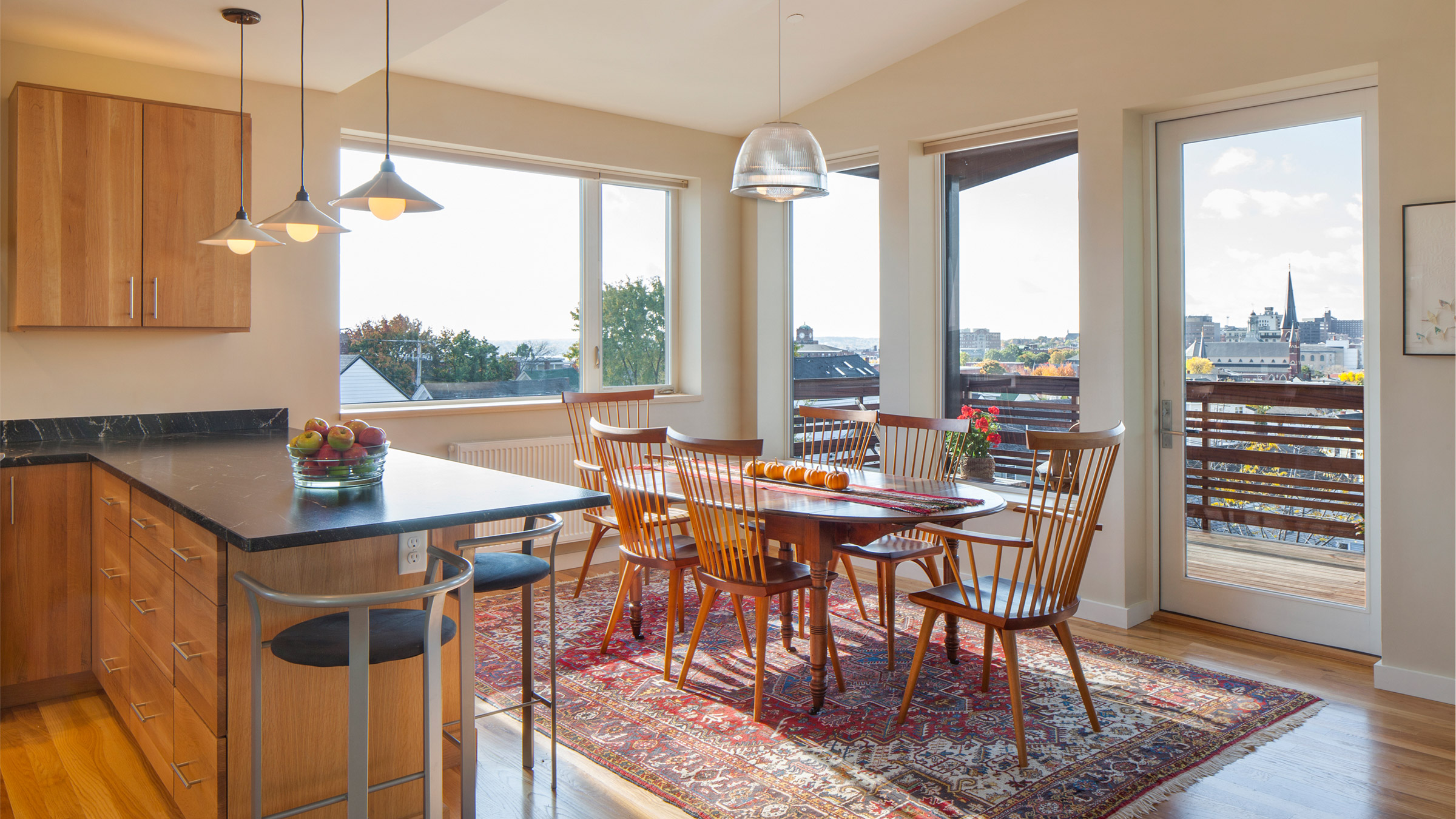
Modern Urban living. An energy efficient four story home with attached garage, on a rare vacant lot in Portland.
The owners of this rare vacant lot on Munjoy Hill wanted a modern, highly energy efficient home that includes a space for two cars, maximizes the available buildable area on the lot and has panoramic views of the City of Portland. The result is a three story home with entry and garage on the first floor, bedrooms and bathrooms on the second, and open concept living, dining, kitchen and outdoor deck on the third floor.
The central staircase is a focal point within the house, organizing the interior spaces and providing natural light on all three levels. An elevator is provided for easy access for the owners and guests. The exterior finishes were chosen for their low maintenance features and to complement the modern home design. The house is highly energy-efficient featuring a thick double-stud wall assembly and triple pane windows.
- Addition + Renovation
- Energy Efficiency
- Phased Renovation/expansion
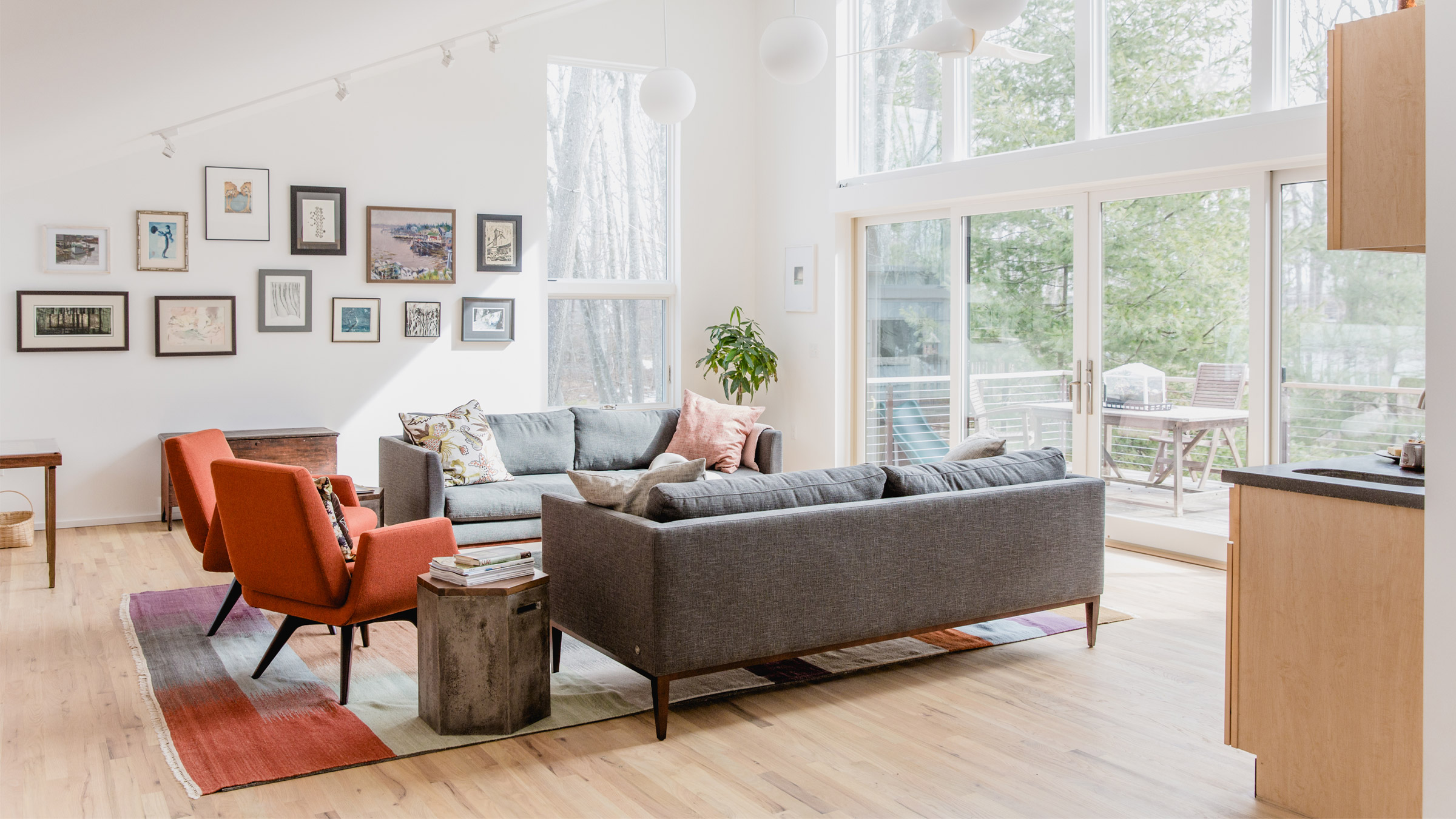
A mid-century split level ranch expanded and modernized to support open concept living, and energy efficiency.
A full renovation with multiple additions was envisioned, with goals for increased space, energy efficiency, sustainability, and modern aesthetics. To minimize the construction schedule, and the construction cost, work was divided into two phases.
Phase one completed in 2016 consisted of a new welcoming two story entrance, mudroom, new two car garage, existing garage converted to art/exercise room, a large family room, and a large outdoor deck facing south.
Phase two scheduled for construction in 2021 includes improvements to the building envelope and HVAC (heating, ventilation, and air conditioning) systems, as required for improved health, comfort, and energy efficiency. In addition, the existing bedrooms and bathrooms are being renovated and expanded, and a new third floor will be added with a primary bedroom suite which includes a spacious bedroom, walk-in closet, and bathroom.

- Net Zero
- Off-grid
- Small House
Quality over quantity – A small sun-filled home poised on a delightful site in western Maine goes Net Zero
Briburn was approached to create a small, affordable, one-person home with the ability to go off the grid as needed or as desired. This meant that the home had to be highly durable, resilient, and energy efficient, even “Net Zero” (able to produce as much energy as it consumes). This was achieved by taking advantage of passive solar design principles, super-insulating the home with a vapor-open, truss-stud construction method, and by using highly efficient European triple pane windows. With the energy demand reduced, the HVAC system was downsized to a single affordable ductless mini-split heat pump system and a small ERV (energy recovery ventilator).
This home is located on a brand new upland pond in Parsonsfield, Maine. The pond was first conceived and permitted for micro-hydro electrical production and it now fills that role providing a small but constant amount of power for the property. The home presently has a solar shed that houses the battery array, meter, and smart inverter. Shortly after the photos shown here were taken, a small covered bridge was built nearby that supports an even larger solar array. The sun shades over the ample southern windows are themselves solar hot water panels.
As with many projects, the budget was very tight. This meant every design decision had to take into account its long and short-term economic effect as well as its contribution to the project. To the owner’s credit, almost nothing was sacrificed when it came to energy efficiency, sustainability, and construction quality. They did, however, contribute a substantial amount of work themselves including site work, masonry work, salvaging old slate for countertops, interior trim, and interior paint including cabinetry. The home is small with an interior that is extremely simple, and open. It is detailed with stained concrete floors, deep window sills and jambs. On the exterior, the home is clad with thermally modified local poplar, douglas fir trim elements, metal roof and masonry that was completed by the homeowners with stone salvaged from the property.

- Passive House PHIUS+
- Net Positive
Maine’s First Net Positive Passive House
TideSmart Global is an experiential marketing company in Falmouth, Maine that is committed to investing in the future of its employees, its community, and the sustainability of the natural environment. When it came time to replace a small residential structure on their campus, they wanted a new building that would meet the highest of energy efficiency standards (Passive House) and serve as an example for the building industry in Maine and beyond.
The result is a certified Passive House that generates far more than twice the energy it consumes, making it significantly net positive with zero emissions. This is achieved by dramatically reducing the building’s energy demand and installing copious amounts of renewable energy in the form of a 19.4 kW solar array that occupies the entire roof. This “extra” power is used to power a vehicle charging station (that is free for public use) and to offset power consumed by other existing buildings on TideSmart’s campus.
Viridescent’s design is founded on passive solar design principles, orienting the building and configuring the fenestration to maximize solar heat gain in the winter and minimize it in the summer. It features a highly insulated and tightly-sealed exterior thermal envelope consisting of vapor-open Larsen truss walls (20” thick filled with dense-packed cellulose), a frost protected slab (8” of polished concrete over 10” of EPS insulation), European triple pane tilt turn windows, and detailed connections that are tenaciously sealed and thermally isolated from the exterior. It also features resource efficient, highly durable, low emitting materials, LED lighting, water efficient fixtures, an energy monitoring system.
- Net Zero Ready
- Deep Energy Retrofit
A deep energy retrofit of an old barn in Falmouth honors its past while creating a contemporary home
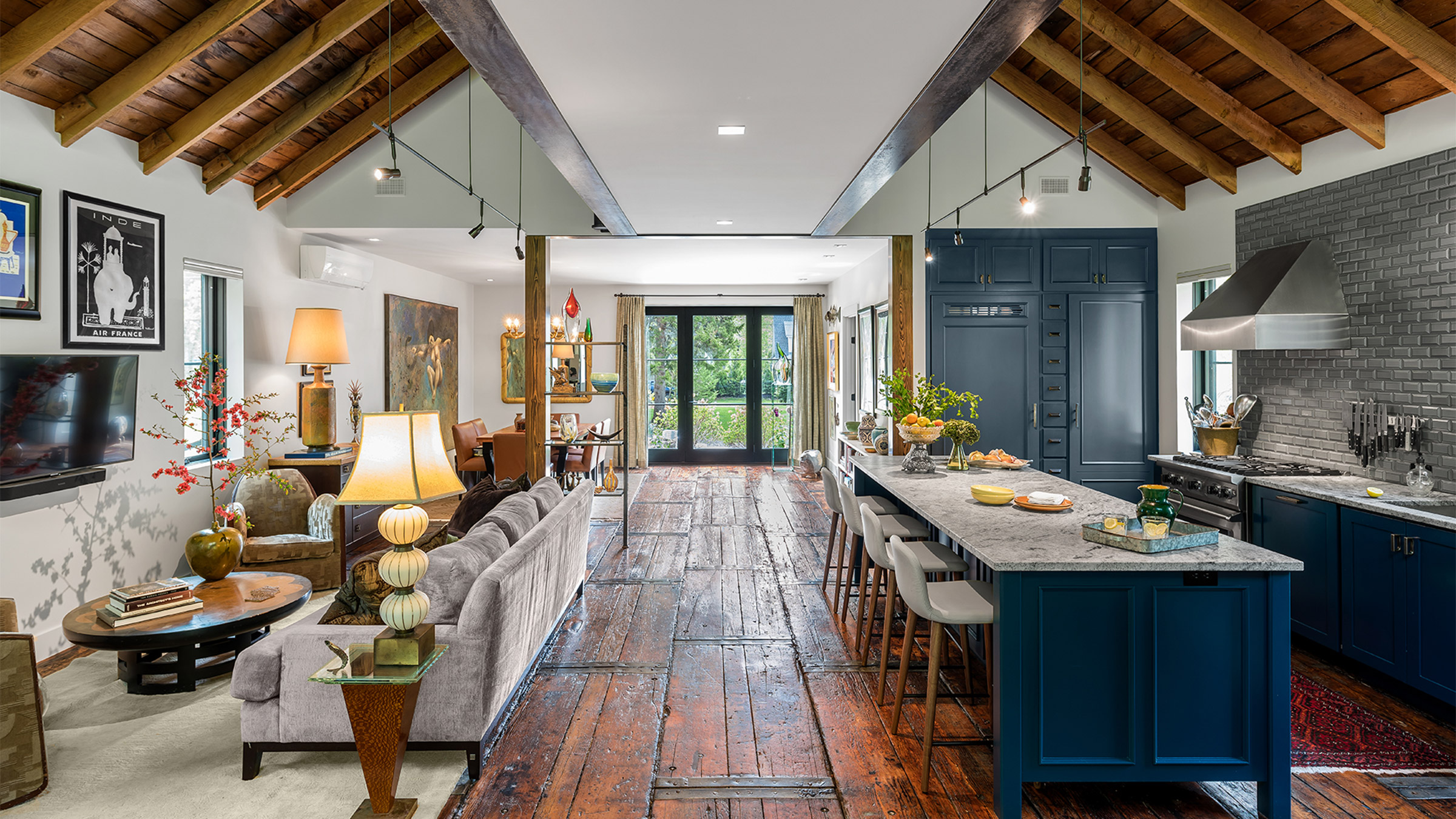
Most people would have torn down this barn to make way for an entirely new structure, but our client had a strong vision. He was enchanted by its many quaint historical features such as the catwalk among the trusses, and the floor made from World War II Liberty Ship hatches. He wanted to honor the past by keeping such features, honor the present by making a comfortable modern place for he and his husband to live, and honor the future by turning the drafty old barn into a highly energy-efficient, sustainable building. This passion was definitely something our firm supported and we’re thrilled to be a part of it.
The process began by visiting the site with the owner and taking an inventory of the building’s assets and liabilities. There were not a lot of the former and plenty of the latter. For one, the building needed an entirely new foundation. It was also lacking any insulation and it had no real running water and only small, marginally code-compliant, electrical service.
We opened up the space occupied by the trusses, turned the catwalk into a structural ridge beam to hold up the new roof, introduced sliding glass doors on the east and modern gabled glass to the west, and added a dormer to the loft creating a cozy bedroom. Working closely with the builder (Emerald Builders) we strategized and designed a super-insulated, well-sealed building envelope that kept much of the existing finishes intact and exposed to the interior. This combined with modern living spaces styled by the client (an interior designer) highlights this remarkable transformation.